Home › CODIPRO › Swivel lifting ring guide
Swivel Lifting Ring Guide
A complete reference: why a swivel lifting ring and not an eye bolt, single, double and triple swivel, WLL and safety factor, how the sling angle raises the load on each point, thread depth and mounting - and every CODIPRO product compared.
Swivel lifting ring or eye bolt
A lifting point connects the load to the sling. The classic one is the fixed eye bolt. It is strong when pulled straight along its thread - and loses much of its capacity as soon as the sling pulls at an angle.
| Fixed eye bolt | Swivel lifting ring | |
|---|---|---|
| Pull straight up | Full capacity. | Full capacity. |
| Pull at an angle | The capacity falls sharply; only shouldered eye bolts may be used, at a reduced load. | The ring turns and tilts into the direction of the sling and keeps its working load limit, within the angles the maker approves. |
| Direction of the eye | Fixed once tightened. If it points the wrong way the eye is bent sideways. | Rotates 360°, so it always lines up with the sling. |
| Turning the load | Not suitable. | Made for it: the ring follows the sling as the load turns. |
Single, double and triple swivel
| Kind | How it moves | Typical use |
|---|---|---|
| Single swivel (swivel eye bolt) | Rotates 360° and turns itself into the direction of the sling. | The swivel version of an eye bolt. |
| Double swivel | Rotates 360° and the shackle swivels 180°. | The general-purpose lifting ring, for lifts from straight up to fully sideways. |
| Triple swivel | Two pivots as well as the rotation. | Tilting, turning and flipping a load. |
| Lateral swivel | Lines up with the force when the load is not purely along the thread. | Loads where the pull is not along the thread. |
How the lifting point is fixed to the load
Male thread
The ring has a bolt and screws into a threaded hole in the load. The usual version, in metric and inch (UNC) threads.
Female thread
The ring has a threaded hole and screws onto a stud, a threaded bar or a bolt of the load.
Long bolt
A swivel ring supplied with a longer bolt, in the lengths stated on the product page.
Quick fit
Pushed into the threaded hole and locked with a button, without screwing, which saves mounting time.
Weld-on
Welded to the load where no thread can be made.
Bolted lifting points
Fixed to the load with screws, for the heaviest loads.
WLL, safety factor and what is marked on the ring
| Term | Meaning |
|---|---|
| WLL Working load limit | The largest load the lifting point may carry in service. It is given per lifting point. |
| Safety factor | How many times the WLL the ring withstands before it breaks. 4:1 means the breaking load is four times the WLL; 5:1 means five times. |
| Tightening torque | The torque the ring must be tightened to. On CODIPRO GRADUP rings it is engraved on the ring with the WLL and the CE mark. |
| LC Lashing capacity | The load a ring may take when it is used to tie a load down, given in daN. A ring with both markings may be used for lashing and lifting. |
| Traceability code | The individual number of a ring. With the RFID option it is stored in a chip in the ring. |
The sling angle: why 4 points do not carry a quarter each
When a sling leg is not vertical it carries more than its share of the weight. The flatter the leg, the higher the force in it - and on its lifting point.
The angle is measured between the sling leg and the horizontal: 90° is a vertical leg. The formula is valid when all legs share the load equally.
| Angle of the leg to the horizontal | Force in the leg, compared with a vertical leg |
|---|---|
| 90° (vertical) | × 1.00 |
| 60° | × 1.15 |
| 45° | × 1.41 |
| 30° | × 2.00 |
Example
A 4 t load on two legs at 45°: 4 ÷ 2 ÷ 0.707 = 2.83 t in each leg. Each lifting point needs a WLL of at least 2.83 t, not 2 t.
Four legs, rigid load
A rigid load on four legs rarely loads all four equally. Unless the load is symmetrical and the legs are exactly equal, calculate as if two legs carry everything.
Keep the legs steep
A steeper sling means less force in every leg and on every lifting point.
Thread depth and mounting
A lifting ring is only as strong as the thread it is screwed into.
| Material of the load | Usual thread engagement |
|---|---|
| Steel | About 1 × the thread diameter |
| Cast iron | About 1.25 × the thread diameter |
| Aluminium | 2 × the thread diameter or more |
- Check the thread in the load: right size, clean, undamaged and deep enough.
- Seat the ring flat: the base must rest fully on a flat surface of the load.
- Tighten with a tool to the torque stated for the ring.
- Check the movement: the ring must turn and tilt freely in the direction of the sling.
- Inspect before each lift: no deformation, cracks, corrosion or damaged thread; the markings must be readable.
Steel, stainless steel and offshore
Steel (GRADUP)
The standard CODIPRO range in high-strength steel, in metric and inch threads.
Stainless steel 316L
For humid, chemical and marine environments.
Offshore
Rings with DNV type approval, also with a full zinc lamellar coating for outdoor use.
Very heavy loads
Large double swivel rings and bolted lifting points carry tens of tonnes, and more than 100 t, on a single point.
Options, automatic hooks and anchor points
| Product | What it does |
|---|---|
| Thread adaptor | Reduces an existing large thread so that a smaller ring fits. |
| Centering | A reinforcement on the base that supports the bolt under side load. |
| Blocking spring | Holds the shackle in position so that it does not hit the load. |
| Overload detector | Gives a visual warning when the WLL has not been respected. |
| RFID chip | Identification and traceability of each ring. |
| Protective washer | Protects the surface of the workpiece under the ring. |
| Automatic lifting hook | Hooks and releases the load from a distance. |
| Mould lifting system | A central lifting system for injection moulds and tools. |
| Fall protection anchor point | Secures people wearing a harness. It is not a lifting ring. |
How to choose - 6 questions
- How heavy is the load, and where is its centre of gravity?
- How many lifting points, and at what sling angle?
- What is the load on each point? Calculate it with the sling angle - see above.
- How is the point fixed? The thread size in the load, male or female, or weld-on.
- What is the load made of? Steel, cast iron or aluminium - it decides the thread depth.
- Where is it used? Indoors, outdoors, marine, chemical or offshore; lifting only, or turning the load.
The CODIPRO range
Lifting points and swivel rings
Single, double and triple swivel rings in steel and stainless steel, female-thread, weld-on, quick-fit and offshore versions, and bolted lifting points for the heaviest loads.
 CODIPRO ARC Bolt-On Lifting Point for Automatic Hooks (ARC 50 / ARC 80)Bolted lifting point
 CODIPRO CSS Central Safety Shackle Lifting Point (WLL 20 / 32 / 55 t)Bolted lifting point · WLL up to 55 t
 CODIPRO DSH Double Swivel Hook-Type Lifting Ring (M8-M20 / UNC 5/16"-3/4", WLL 0.4-2.5 t)Swivel ring · WLL up to 2.5 t
 CODIPRO DSP Double Swivel Lifting Point (M8-M20 / UNC 5/16"-3/4", WLL 0.4-2.5 t)Swivel ring · WLL up to 2.5 t
Lifting accessories
Automatic lifting hooks, lifting systems for injection moulds, and the options for swivel rings: thread adaptor, centering, blocking spring, overload detector, RFID chip, protective washer and torque key.
 CODIPRO ADA Thread Adaptor for Swivel Lifting Rings (M24-M100 / UNC 7/8"-4")Accessory
 CODIPRO Blocking Spring for Swivel Lifting Rings (DSR / DSS / DSP / DSH / TSR)Accessory
 CODIPRO Centering Option for Swivel Lifting Rings (DSR / DSS / SEB / TSR / DSP / DSH)Accessory
 CODIPRO ELR Centralised Lifting System for Moulds (25 / 40 / 60 t, integrated RFID)Mould lifting system · WLL up to 60 t
Lashing points
Swivel rings marked with a lashing capacity, for securing a load as well as lifting it.
See all lashing points →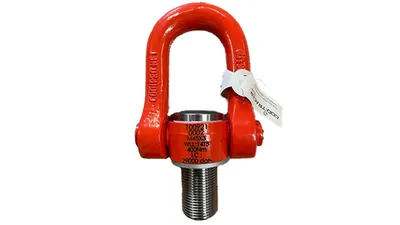
Full comparison table
Every CODIPRO product we list, with the thread range and the largest WLL of the range as its name states them. Click a column heading to sort; use the box to show one group.
Common questions
Can I use a normal eye bolt for an angled lift?
Only a shouldered eye bolt, and only at a strongly reduced load. A swivel lifting ring is made for angled lifts.
Does a swivel ring keep its WLL at any angle?
Within the angles the maker approves for that ring. They are given in its user instructions and on the product page.
What size do I need for a 10 t load on 4 points?
Not 2.5 t. With a rigid load, count two points, and add the effect of the sling angle. At 45° that is 10 ÷ 2 ÷ 0.707 = about 7.1 t per point.
Can a lifting ring be used to lash a load?
Only a ring that carries the LC (lashing capacity) marking.
Can a lifting ring be used as an anchor for a safety harness?
No. Use a fall protection anchor point made for people.
What do you need to quote?
The model or the application, the thread size, the WLL and the quantity. Send them by WhatsApp or to info@west-velocity.com.
Glossary
| Term | Meaning |
|---|---|
| Eye bolt | A bolt with a fixed ring-shaped head, used as a simple lifting point. |
| Female thread | A threaded hole; a female ring screws onto a stud. |
| Lashing | Tying a load down for transport. |
| Lifting point | The part fixed to the load to which the sling is attached. |
| Safety factor | Breaking load divided by the WLL. |
| Shackle | The U-shaped link of the ring that takes the hook or sling. |
| Sling angle | The angle of a sling leg; here measured to the horizontal. |
| Swivel | Able to rotate or tilt under load. |
| UNC | The coarse inch thread series. |
| WLL | Working load limit: the largest load allowed in service. |
Find the right CODIPRO lifting ring
Not sure which CODIPRO lifting ring you need?
Tell us the kind of lifting point and the load on each point - we show the CODIPRO products made for it. New to swivel lifting rings? Read the guide →
This guide is general information to help you choose. Every lift must be planned by a competent person, and the user instructions and markings of each lifting ring must be followed; send us your application and we will confirm the model with the maker.