What an arc flash is, and why ordinary workwear is not enough
An arc flash is an electrical fault in which current jumps through the air between conductors, or from a conductor to earth. For a fraction of a second it releases intense heat and light, together with a pressure wave, molten metal and noise.
The heat is the main injury risk
The energy that reaches a person is called incident energy and is measured in calories per square centimetre (cal/cm²). The closer the person and the longer the fault lasts, the higher it is.
Ordinary clothing can make it worse
Everyday workwear can ignite and keep burning after the arc has ended, and synthetic fabrics such as polyester can melt onto the skin. Burns from burning clothing are often worse than burns from the arc itself.
What arc flash clothing does
Arc-rated clothing is tested against an electric arc. It must not ignite, melt or break open at its rated level, and it limits the heat that passes through to the skin.
How the arc energy at a workplace is worked out
The clothing needed at a switchboard is decided by the incident energy a person could receive there, in cal/cm². It is calculated for each piece of equipment in an arc flash study, most often with the method of IEEE 1584.
| What decides the incident energy | Effect |
|---|---|
| Fault current available at that point | More current means more power in the arc. |
| Clearing time of the protection (fuse or breaker) | The energy grows with every fraction of a second the arc lasts. A slow protection setting can produce more energy than a higher fault current that is cleared quickly. |
| Working distance from the arc to the body | The energy falls quickly with distance. Hands are closer than the chest, which is why gloves and face protection matter. |
| Enclosure: open air or inside a cubicle | An arc in a box is directed out of the open front, towards the worker. |
| Voltage, conductor gap and electrode layout | They decide whether an arc sustains itself and how it moves. |
Low voltage is not low risk
Many serious arc flash burns happen on low-voltage equipment, where fault currents are high and protection can be slow to clear. The voltage alone does not tell you the clothing needed.
The 1.2 cal/cm² line
An incident energy of 1.2 cal/cm² on bare skin is taken as the onset of a second-degree burn. The distance at which the energy falls to that level is the arc flash boundary; inside it, arc-rated clothing is required.
What you need from the study
For each panel: the incident energy at the working distance, the arc flash boundary, and the clothing level your site assigns to it. That figure is what you match against the garment label.
Reading the rating on the label
Arc flash garments are tested in two different ways, so a label can carry two kinds of rating. Many garments carry both.
| On the label | What it is | How to use it |
|---|---|---|
| ELIM (cal/cm²) | Incident energy limit, from the open arc test (IEC 61482-1-1). The highest incident energy at which the test predicts no second-degree burn. | The cautious figure. Compare it with the incident energy from your arc flash study: the ELIM should be equal or higher. |
| ATPV (cal/cm²) | Arc thermal performance value, from the same open arc test. The incident energy at which there is a 50% probability of a second-degree burn. | Higher than the ELIM of the same fabric. Many site rules written around ATPV are still in use. |
| EBT (cal/cm²) | Breakopen threshold energy: the incident energy at which there is a 50% probability that the fabric breaks open. Reported in place of ATPV for fabrics that break open before the burn limit is reached. | Read it the same way as ATPV. |
| APC 1 or APC 2 | Arc protection class, from the box test (IEC 61482-1-2): a directed arc of 4 kA for class 1 or 7 kA for class 2, for half a second. | A pass or fail at a fixed test level. Class 2 is the higher level. |
The two arc tests in detail
EN 61482-2 is the garment standard. It refers to two test methods, which answer different questions.
| Open arc test | Box test | |
|---|---|---|
| Test standard | IEC 61482-1-1 | IEC 61482-1-2 |
| Set-up | An arc in open air between two electrodes, with fabric panels and instrumented sensors around it. The energy is varied from shot to shot. | An arc inside a plaster box that is open on one side, so the arc is directed at the sample 300 mm away. Fixed test conditions: 400 V, 500 ms. |
| Result | A number in cal/cm²: ELIM, and ATPV or EBT. | Pass or fail at a class: APC 1 at 4 kA, APC 2 at 7 kA. |
| Energy level | Whatever the fabric reaches; garments in this range state from under 5 to over 40 cal/cm². | Fixed by the class: the arc releases about 168 kJ in the class 1 test and about 320 kJ in the class 2 test. |
| Pass criteria | Heat through the fabric is compared with the Stoll curve (the second-degree burn limit); the fabric must not break open, melt or keep burning. | Heat through the sample stays below the Stoll curve; no hole formation, no melting through to the inside, and burning must stop within the short time the standard allows. |
| Use it when | Your study gives an incident energy in cal/cm². | Your site rules name an arc class. |
PPE categories (NFPA 70E)
Sites that work to the American standard NFPA 70E use its four PPE categories. The standard groups arc-rated clothing into four PPE categories by the minimum arc rating of the whole outfit.
| PPE category | Minimum arc rating | ProGARM products that state it |
|---|---|---|
| Category 1 | 4 cal/cm² | 127 |
| Category 2 | 8 cal/cm² | 108 |
| Category 3 | 25 cal/cm² | 22 |
| Category 4 | 40 cal/cm² | 8 |
The standards you will see on a garment label
An arc flash garment usually protects against more than the arc. These are the standards stated on the ProGARM garments we list, with the number of products that state each one.
| Standard | What it covers | Products |
|---|---|---|
| EN 61482-2 (IEC 61482-2) | Protective clothing against the thermal hazards of an electric arc. This is the arc flash standard: the garment label shows an arc class (APC 1 or APC 2) and / or an arc rating in cal/cm². | 129 |
| EN ISO 11612 | Protection against heat and flame: limited flame spread and the heat-transfer tests shown by the code letters A to F on the label. | 137 |
| EN ISO 11611 | Protective clothing for welding and allied processes. | 78 |
| EN 1149-5 | Electrostatic properties: the garment is made to avoid incendiary static discharges, as part of a fully earthed system. | 134 |
| EN ISO 20471 | High-visibility clothing, in classes 1 to 3 according to the area of fluorescent and reflective material. | 82 |
| EN 343 | Protection against rain: resistance to water penetration and breathability. | 26 |
| EN 13034 | Limited protection against liquid chemicals (type 6: light spray and small splashes). | 45 |
| EN ISO 14116 | Limited flame spread materials and clothing. | 2 |
The codes on the label, decoded
EN ISO 11612: letters A to F
| A1 / A2 | Limited flame spread (surface / edge ignition) |
| B1 - B3 | Convective heat (flame) |
| C1 - C4 | Radiant heat |
| D1 - D3 | Molten aluminium splash |
| E1 - E3 | Molten iron splash |
| F1 - F3 | Contact heat |
A higher number is a higher level of that protection.
EN ISO 20471: high visibility
| Class | Fluorescent | Reflective |
|---|---|---|
| 3 | 0.80 m² | 0.20 m² |
| 2 | 0.50 m² | 0.13 m² |
| 1 | 0.14 m² | 0.10 m² |
Minimum areas of visible material. A jacket and trousers worn together can reach a higher class than either alone, when the maker certifies the combination.
The other marks
EN 343 shows two figures on the label: the class for resistance to water penetration and the class for breathability. A higher class is better for both.
EN ISO 11611 has class 1 for lighter welding with less spatter and class 2 for heavier welding.
EN 1149-5 is the standard for antistatic (electrostatic dissipative) clothing. Its companion parts are the test methods: EN 1149-1 for surface resistivity and EN 1149-3 for charge decay. The clothing only works as part of a fully earthed system, so the wearer must be earthed, for example through suitable footwear.
EN 13034 Type 6 is limited protection against light spray of liquid chemicals. Type PB [6] covers only part of the body.
How to choose arc flash clothing - 7 steps
- Start from the arc flash study. Your site's risk assessment gives the incident energy (cal/cm²) at each piece of equipment, or the arc class it requires. That figure decides the clothing, not the voltage alone.
- Choose a rating equal to or above it. Compare the incident energy with the garment's ELIM or ATPV, or match the required arc class.
- Cover the whole body. Use a coverall, or a jacket with trousers or dungarees. Tops and bottoms should both be arc-rated, with no bare skin or ordinary clothing showing between them.
- Think in layers. A base layer, a shirt and a jacket worn together protect more than one garment alone, but the rating of a combination is only known if the maker has tested that combination. Do not add the figures of separate garments together yourself.
- Protect head, face and hands. For switching and higher-energy work add an arc-rated helmet and visor or a switching hood, and arc flash gloves.
- Add the other hazards of the job. High visibility for traffic and plant areas, waterproof for outdoor work, antistatic for explosive atmospheres, welding or chemical splash where they apply.
- Get the fit right. Clothing that fits is worn properly: sleeves down, front closed. Ladies-fit garments are listed where the maker offers them.
Fabric technology
Inherent or treated
Inherent flame resistance is a property of the fibre itself, so it cannot be washed or worn out of the fabric. Treated fabrics are ordinary fibres, usually cotton, given a flame-retardant finish; they rely on correct laundering to keep it. 64 of the ProGARM products we list describe their fabric as inherent.
Fabric weight (gsm)
Weight is given in grams per square metre. Heavier fabrics generally reach higher arc ratings but are warmer to wear. Where the maker states it, the garments we list range from 160 to 395 gsm (61 products state a weight). Weight alone does not give the rating - compare the tested figures.
Woven, knitted, laminated
Woven fabrics are used for coveralls, jackets and trousers. Knitted fabrics (jersey, interlock, pique) are used for polo shirts, T-shirts and base layers. Laminates add a waterproof, breathable membrane for outdoor garments.
Named in the ProGARM range
VXS+ is ProGARM's own inherent fabric family, named on 70 of the products we list. GORE-TEX PYRAD waterproof arc-rated fabric technology is named on 19. Each product page states its fabric as the maker gives it.
Heat in the Gulf climate
Heat stress is a real risk in hot weather. Lighter fabrics and breathable knits are easier to wear correctly all shift; choose the lightest garment that still meets the required arc rating, never a lower rating for comfort.
Trims count too
Thread, zips, buttons, reflective tape, labels and logos must also be flame-resistant. A melted zip or an ordinary embroidered badge can injure through an otherwise sound garment.
Layering
Layers are how higher protection is reached without one very heavy garment, and how one wardrobe covers both everyday tasks and switching.
| Layer | Typical garment | What it adds |
|---|---|---|
| Base layer | Flame-resistant underwear, long-sleeved T-shirt | Nothing next to the skin that can melt; an extra air gap. |
| Everyday layer | Arc-rated polo shirt or sweatshirt with arc-rated trousers | The protection worn all day for routine tasks. |
| Outer layer | Arc-rated jacket, coverall, waterproof or switching suit | Put on for higher-energy tasks and for weather. |
Why layers work
The air trapped between layers insulates, so two layers often protect more than their two ratings added together would suggest.
The rule
The rating of a combination is only valid if that combination was tested. Ask for the maker's tested layering figures; do not add ratings yourself.
Every layer flame-resistant
An ordinary garment between or under arc-rated layers can ignite or melt if the outer layer breaks open. An ordinary garment worn on top - a rain jacket or hi-vis vest - can burn on the outside.
Head, face and hands
Helmet and visor
The face is usually closest to the arc. Arc-rated helmets with visors are tested and marked with their own class or arc rating. A visor also darkens the view, so check the light transmission for the task.
Switching hood
For the highest-energy switching work a hood covers the whole head and neck and is worn with a switching jacket and dungarees of the same rating.
Gloves
Arc flash gloves protect against the heat of the arc. They are not the same as electrical insulating gloves, which protect against shock; where both risks exist the system for both must be worn as its makers instruct.
Balaclavas, liners and neck
A flame-resistant balaclava or helmet liner closes the gap between collar and helmet. Hearing protection and eyewear worn underneath should be suitable for arc flash work too.
Which garment for which job
The ProGARM range by garment type. The arc ratings shown are the lowest and highest figures the maker states for the products in each group.
Coveralls
One garment that covers body, arms and legs with no gap at the waist. The usual choice for maintenance, switching and plant work.
 ProGARM 6444 Multinorm Arc Coverall (9 cal/APC 1)ELIM 9 cal/cm² · Arc class 1
 ProGARM 6446 Ladies Multinorm Arc Coverall (9 cal/APC 1)ELIM 9 cal/cm² · Arc class 1
 ProGARM 4658 Orange Two-Tone Coverall (8 cal/APC 1)8 cal/cm² · Arc class 1
 ProGARM 4690 Arc Coverall (8 cal/APC 1)ELIM 8 cal/cm² · Arc class 1
Jackets and coats
Worn with arc-rated trousers or dungarees. Includes waterproof and insulated jackets for outdoor work.
 ProGARM 9505F ARC 4 Female Switching Suit Jacket with PYRAD® Technology by GORE-TEX LABS ELIM (40 cal/APC 2)ELIM 40 cal/cm² · Arc class 2
 ProGARM 9505M ARC 4 Switching Suit Jacket with PYRAD® technology by GORE-TEX LABS (40 cal/APC 2)ELIM 40 cal/cm² · Arc class 2
 ProGARM® WJ240F Female GORE-TEX® PYRAD® Stretch Jacket (30 cal/APC 2)ELIM 30 cal/cm² · Arc class 2
 ProGARM® WJ240M Orange GORE-TEX® PYRAD® Stretch Jacket – Male Fit (30 cal/APC 2)ELIM 30 cal/cm² · Arc class 2
Trousers
Worn with an arc-rated jacket, polo shirt or sweatshirt. Includes waterproof salopettes.
 ProGARM 9660 Waterproof SalopetteELIM 42 cal/cm² · Arc class 2
 ProGARM 9880 42 Cal Waterproof SalopetteELIM 42 cal/cm² · Arc class 2
 ProGARM® WT240F GORE-TEX® PYRAD® Stretch Trousers – Female Fit ELIM 30 cal APC 2ELIM 30 cal/cm² · Arc class 2
 ProGARM® WT240M GORE-TEX® PYRAD® Stretch Trousers (30 cal/APC 2)ELIM 30 cal/cm² · Arc class 2
Dungarees
Bib-and-brace protection for the legs and torso, worn with an arc-rated top or jacket.
 ProGARM 9515F ARC 4 Female Switching Suit with PYRAD® TECHNOLOGY by GORE-TEX LABS (40 cal/APC 2)ELIM 40 cal/cm² · Arc class 2
 ProGARM 9515M ARC 4 Switching Suit Dungaree with PYRAD® TECHNOLOGY by GORE-TEX LABS (40 cal/APC 2)ELIM 40 cal/cm² · Arc class 2
 ProGARM® WT252F GORE-TEX® PYRAD® Stretch Trousers – Female Fit (30 cal/APC 2)ELIM 30 cal/cm² · Arc class 2
 ProGARM® WT252M GORE-TEX® PYRAD® Stretch Trousers – Male Fit (30 cal/APC 2)ELIM 30 cal/cm² · Arc class 2
T-shirts and polo shirts
Arc-rated tops for day-to-day wear and as the layer under a jacket.
 ProGARM 5200 Arc Polo Shirt ELIM 11 cal APC 1 (11 cal/APC 1)ELIM 11 cal/cm² · Arc class 1
 ProGARM 5202 Ladies Arc Polo Shirt (11 cal/APC 1)ELIM 11 cal/cm² · Arc class 1
 ProGARM 5480 Two-Tone Arc T-Shirt (11 cal/APC 1)ELIM 9.9 cal/cm² · Arc class 1
 ProGARM 5482 Ladies Two-Tone Arc T-Shirt (11 cal/APC 1)ELIM 9.9 cal/cm² · Arc class 1
Sweatshirts
A warmer arc-rated top, also used as a mid layer.
 ProGARM 5530 Arc Flash Hoodie (12 cal/APC 1)ELIM 12 cal/cm² · Arc class 1
 ProGARM 5626 Arc Sweatshirt – Arc Rated Sweatshirt ELIM (12 cal/APC 1)ELIM 12 cal/cm² · Arc class 1
 ProGARM 5630 Navy Arc Flash Sweatshirt (12 cal/APC 1)ELIM 12 cal/cm² · Arc class 1
 ProGARM 5648 Arc Sweatshirt (9.9 cal/APC 1)ELIM 9.9 cal/cm² · Arc class 1
Base layers
Flame-resistant underwear worn next to the skin under arc-rated garments.
 ProGARM 8700-F Ladies FR Boxer BriefsArc rating on request
 ProGARM 8700-M Mens FR Boxer BriefsArc rating on request
Head and face protection
Switching hoods for higher-energy switching work.
See all head and face protection →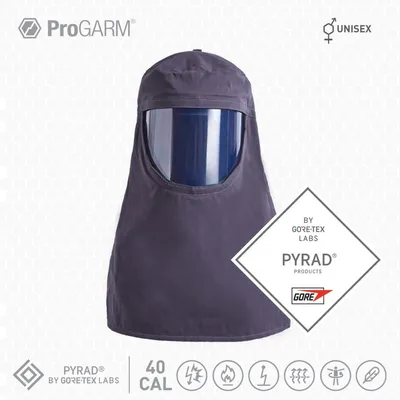
Gloves, helmets, hoods and accessories
Arc flash gloves, helmets with arc visors, balaclavas, helmet liners and other flame-resistant accessories that complete the outfit.
 ProGARM 2678 Arc Flash Gloves (FR / 50cal)50 cal/cm²
 ProGARM 2696 36 cal Arc Flash Safety HelmetATPV 36 cal/cm² · Arc class 2
 ProGARM WH240H GORE-TEX® PYRAD® Stretch helmet size hood (30 cal/APC 2)ELIM 30 cal/cm² · Arc class 2
 ProGARM WH240S GORE-TEX® PYRAD® Stretch hood (30 cal/APC 2)ELIM 30 cal/cm² · Arc class 2
ProGARM garments by arc rating
How many of the listed products state at least each level. The figure used is the lowest arc rating the maker states for the product.
Full comparison table
Every ProGARM product we list that states an arc rating, with the figures exactly as the maker gives them. Click a column heading to sort; use the box to show one garment type.


Wearing and looking after arc flash clothing
Wear it closed
Fasten the front fully, keep sleeves rolled down and cuffs closed, and tuck nothing flammable on top. A garment worn open does not protect the area it leaves uncovered.
Mind what is underneath
Avoid synthetic underwear and shirts that can melt under an arc-rated outer layer. Flame-resistant base layers are made for this.
Wash as the label says
Follow the maker's care label for temperature and detergent. Do not use bleach or fabric softener unless the label allows it.
Inspect before use
Check for holes, tears, worn fabric, broken fasteners and contamination with oil, grease or flammable liquids. Take damaged or contaminated garments out of use.
Repair correctly
Repairs need flame-resistant thread and matching material, as the maker instructs. An ordinary patch or thread is a weak point.
After an arc
A garment that has been exposed to an arc flash has done its job. Replace it; do not put it back into service.
Common questions
Is flame-resistant the same as arc-rated?
No. All arc-rated clothing is flame-resistant, but a flame-resistant garment is arc-rated only if it has been tested against an electric arc and carries an arc rating or arc class.
Is a higher cal rating always better?
Not always. Higher ratings usually mean heavier garments or more layers. Choose the rating the risk assessment requires, in a garment people will wear correctly for the whole shift.
ELIM or ATPV: which do I use?
Use the one your site rules name. Where they do not say, ELIM is the more cautious figure, because it is set where no second-degree burn is predicted.
Does arc class 2 cover arc class 1?
Yes. Class 2 is tested at a higher current (7 kA) than class 1 (4 kA), so a class 2 garment also meets a class 1 requirement.
Can I wear a polo shirt alone?
Only with arc-rated trousers or dungarees, and only if the polo's own rating meets the incident energy of the task. The legs need the same protection as the body.
What information do you need to quote?
The garment types, the arc rating or class required, any extra needs (high visibility, waterproof), sizes and quantities. Send them by WhatsApp or to info@west-velocity.com.
Glossary
| Arc flash boundary | The distance from a possible arc at which the incident energy falls to 1.2 cal/cm². |
| Arc rating | The tested protection of a fabric or garment in cal/cm² (ELIM, ATPV or EBT). |
| APC | Arc protection class from the box test: APC 1 (4 kA) or APC 2 (7 kA). |
| ATPV | Arc thermal performance value: incident energy with a 50% probability of a second-degree burn through the fabric. |
| Breakopen | A hole forming in the fabric during the arc, which lets heat and flame through. |
| cal/cm² | Calories per square centimetre, the unit of incident energy. 1 cal/cm² is about 41.8 kJ/m². |
| EBT | Breakopen threshold energy: the incident energy with a 50% probability that the fabric breaks open. |
| ELIM | Incident energy limit: the highest energy at which no second-degree burn is predicted. |
| FR | Flame-resistant: the fabric does not keep burning when the flame is removed. |
| gsm | Grams per square metre, the weight of a fabric. |
| Incident energy | The heat energy arriving on a surface at a given distance from the arc. |
| Inherent | Flame resistance that is a property of the fibre, not a finish applied afterwards. |
| Multinorm | A garment certified to several standards at once, for example arc, flame, antistatic and chemical splash. |
| Stoll curve | The relation between heat and exposure time at which a second-degree burn begins; the pass limit in arc tests. |
| Switching suit | A high-rated jacket, dungaree and hood worn for operating switchgear. |
Find the right ProGARM garment
Not sure which arc flash garment you need?
Tell us the garment and the arc protection your risk assessment asks for - we show the ProGARM garments that state it. New to arc flash clothing? Read the guide →
This guide is general information to help you choose. The arc flash risk assessment for your site, and the label and datasheet of each garment, decide what must be worn.